Author Stephen Drew
  • Home
  • Journal
  • About
  • Contact info
  • The Books

Grace (10)

1/7/2024

 
Picture

         A note for readers: This is the tenth in a series of articles intended to describe my experience of walking two of the many pilgrimage routes that make up Spain’s Camino de Santiago. Although I documented those experiences on Facebook as they were unfolding in October 2023, this is a much deeper look into their implications.

             Should you need to review previous articles for context, please scroll down.

                                                                                     *****


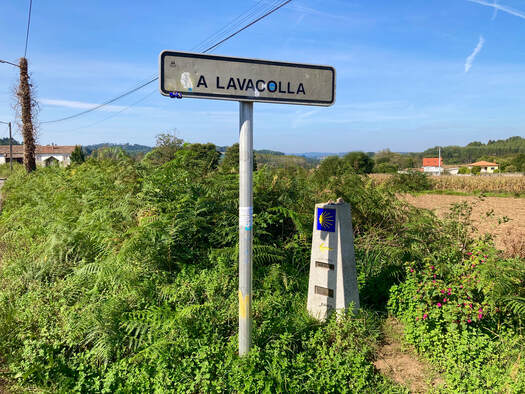
          Seven years ago, when I last walked through the village of Lavacolla, the rain was torrential. It had been relentless for 18 kilometers since leaving Salceda, the hamlet where I’d spent the previous night. As I recall, it had finally tapered to drizzle not too far beyond where I am now. Then, my pace was almost frantic. I was soaked and wanted to be done with it. But today, under a clear sky, warm temperature, and a gentle breeze, I am sauntering, basking in well-being as I move through this landscape I still remember well. 
​
Picture

​         By the time I leave Lavacolla, I’ve already encountered more pilgrims on this road than I did on the entire Camino San Salvador. These days, the French route of the Camino de Santiago is crowded. It’s likely that many of the people I’ve joined have walked 800 kilometers from St. Jean Pied de Port in France. Among them, I feel as though I’m an imposter, as if I should have a sign on my backpack that says I’ve only walked today from the airport. But I do feel a bit road weary after the trek from Leon to Oviedo, so that has to count for something. I smile at all whom I meet and wish them Buen Camino. No one as yet has called me a fraud.

         I have some unfinished business before reaching Santiago. There is a special place that gloomy weather had kept me from fully experiencing last time, so I must make amends.

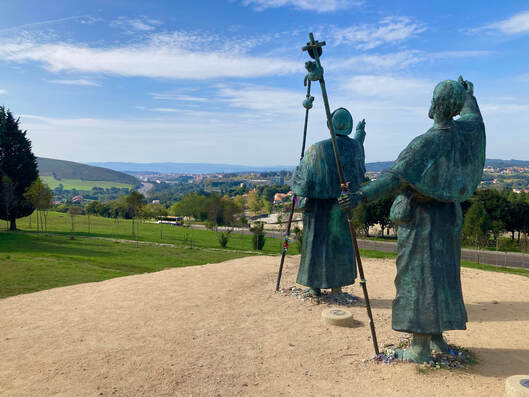
         Just prior to the final, long descent into the outskirts of the city, but still over four kilometers from the Cathedral of St. James, I follow a path to my left that leads across a large, open park space toward a rolling hill about a half kilometer away. A few minutes later, I arrive at Monte do Gozo and the two statues stationed there depicting pilgrims beholding their first view of the distant cathedral spires. It is a traditional, final detour from the French route ̶̶ ̶ the inspiring, penultimate experience of a trek that for many exhausted pilgrims was a walk across the breadth of Spain and their own inner landscape. As for me, I feel welcomed.

Picture

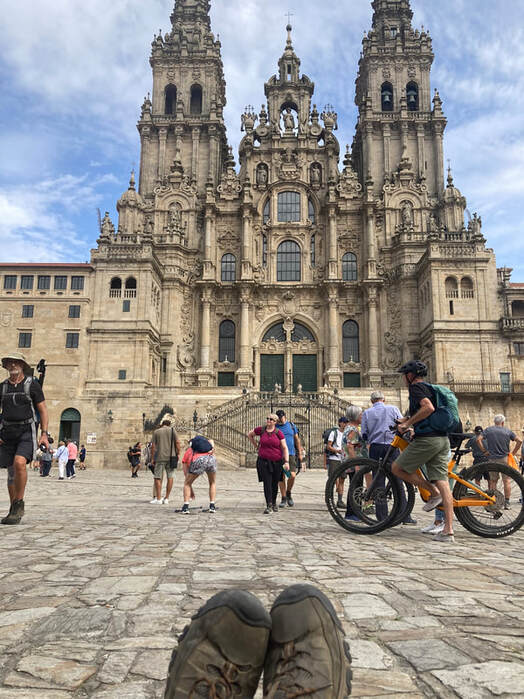
​           Returning to the route, I head down the hill and begin a long trudge to the Old Quarter of Santiago, the end point of the Camino’s most-walked routes. Although I take note of the yellow arrows and scallop shells that are meant to guide me through the streets, I’m navigating mostly from memory now. Drawing closer, I note the changes in the architecture and street surfaces as they take on that medieval Roman look, and finally see one of the cathedral’s spires not far ahead. Next, I hear the echo of the bagpipes being played under the archway that leads to the Praza de Obradoiro, and soon I’m in the middle of the open plaza teeming with pilgrims. Standing before the western façade of the Cathedral of Saint James, I drop my pack, and, using it as a backrest, stretch out for a while on the cobblestone surface in the final posture of the walk. After seven years, a very different pilgrim has arrived home.  
​
Picture

                                                                                    *****

          After a good night’s sleep at my hotel in the heart of the Old Quarter, I begin my one allotted day in Santiago with a walk around the cathedral, a light breakfast, and a trip to the laundromat. These things aside, I turn my attention to the Pilgrim Mass offered daily at noon.

          Although I’ve documented my precarious relationship to Catholicism elsewhere, it remains essential for me to attend this Mass, one that has been offered continuously for over 800 years. Once again, I find myself in yet another cathedral, engaging in another walk through time. But here, the energy of pilgrimage is palpable, felt in the bones, the heart, and the soul. It is in the air of the place. Though the increase in crowds since my last time here has changed the flavor of the experience, its spirit remains intact, and I leave feeling uplifted and well prepared for my walk to the coast tomorrow.

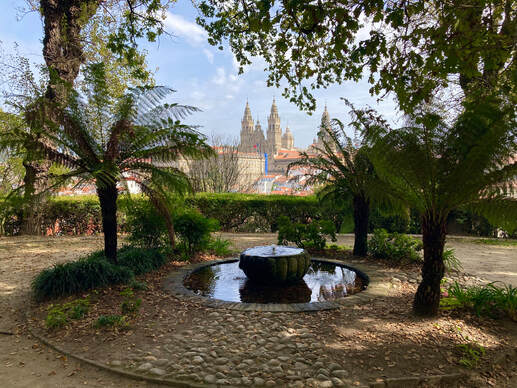
           For the remainder of my day in Santiago, I wander about town, visit a local park that affords a gorgeous view of the Cathedral, and visit with an old friend who now lives here full time. During the late afternoon, I note the changing character of the sky. For the first time since arriving in Spain ten days ago, clouds have appeared.

          I’ve resisted looking at the weather forecast, but I knew the change would come. The region of Galicia is Spain’s version of our Pacific Northwest. And in October, especially, it begins to rain. So when I awaken next morning to the sound of wind-driven rain pelting the window, I’m not surprised. In fact, I actually smile. It’s just so very right.

          I put the pack cover on, shoulder the bag, and don my heavy duty poncho, one that I purchased in Burgos on my very first Camino. It’s still a pain in the ass to put a poncho on. Outside now, the wind is funneling through the streets so that the rain is coming sideways. I make my way toward the Cathedral and head diagonally across the Praza de Obradoiro, sheets of rain meeting me head on. This is pilgrimage in Galicia, and I am ecstatic. I join with the Camino Finisterre route, and begin my walk to the Atlantic.

             Next: Eucalyptus forests and the language of trees.


Comments are closed.
Proudly powered by Weebly
  • Home
  • Journal
  • About
  • Contact info
  • The Books